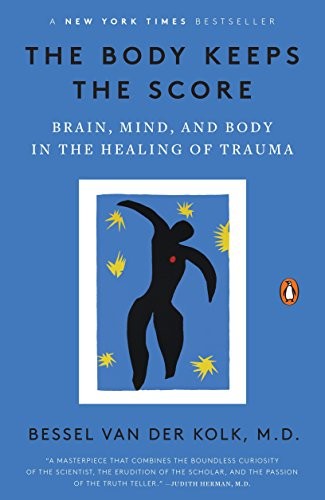
The Body Keeps the Score
As long as you keep secrets and suppress information, you are fundamentally at war with yourself.
Why read it
Trauma isn't a story you failed to get over — it's a reorganization of your brain and body that keeps reliving what the mind wants to forget. Van der Kolk's landmark synthesis explains why talk alone often isn't enough, and what actually heals.
Traumatic experience changes the brain's alarm system, stress-hormone regulation, and the very circuits that distinguish past from present — which is why survivors react to reminders as if the event is happening now. Recovery therefore has to include the body: from EMDR and neurofeedback to yoga and theater, the paths that work restore a felt sense of safety and ownership of oneself.
Van der Kolk spent four decades treating trauma — starting with Vietnam veterans at the Boston VA in the 1970s, when PTSD didn't officially exist. The book distills a career of clinical practice and imaging research at his Trauma Center, and became an unlikely cultural phenomenon, spending years atop bestseller lists.
- 01
Trauma lives in the body
You'll understand flashbacks, numbness, and chronic pain as physiology — the smoke detector of the brain stuck in the on position — not character weakness.
- 02
Why talk therapy hits limits
Broca's area — the speech center — goes offline during flashbacks; you literally cannot talk your way through what the body is re-experiencing.
- 03
Developmental trauma
Chronic childhood abuse and neglect shape a different condition than single-incident PTSD — and van der Kolk's fight to get it recognized is a story in itself.
- 04
The healing toolbox
Evidence and case studies for EMDR, neurofeedback, internal family systems, yoga, and communal theater — with honest accounts of what each can and can't do.
A veteran spends every anniversary of his friend's death unconsciously staging armed standoffs with police — until therapy reveals the date's meaning. His body kept an appointment his mind refused to remember.
In a yoga study with chronically traumatized women, participants who had failed years of talk therapy improved measurably — some could finally feel their own heartbeat without panicking.