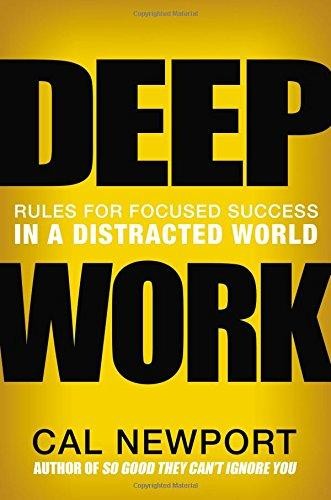
Deep Work
by Cal Newport
Clarity about what matters provides clarity about what does not.
Why read it
In an economy that rewards rare focus while training you for constant distraction, the ability to concentrate without interruption is becoming both scarcer and more valuable — and Deep Work is the playbook for reclaiming it.
Newport splits modern work into two kinds: deep work (cognitively demanding, value-creating, hard to replicate) and shallow work (logistical busywork that feels productive). His thesis: those who cultivate deep work will thrive; those who default to shallow work are increasingly replaceable. The second half is a training program — four rules to make depth a daily practice.
As a computer-science professor at Georgetown, Newport noticed his most productive colleagues weren't the busiest — they were the best at disappearing to think. He wrote the book as a defense of that discipline, drawing on his own record: multiple books and a tenure-track research career without working evenings.
- 01
Deep work vs. shallow work
You'll learn to audit your week and distinguish work that creates value from work that merely looks important.
- 02
The four philosophies of depth
Monastic, bimodal, rhythmic, journalistic — pick the scheduling style that fits your life instead of copying someone else's morning routine.
- 03
Embrace boredom
Focus is a muscle: if you reach for your phone at every idle moment, you're training the opposite skill. Newport shows how to rebuild tolerance for thinking.
- 04
Drain the shallows
Concrete tactics — fixed-schedule productivity, quantifying the depth of every task, saying no — to cut shallow work to under an hour a day.
Carl Jung built a stone tower in Bollingen with no electricity, retreating from a busy Zurich clinical practice to think. The work he produced there reshaped psychiatry — while his rival Freud stayed prolifically "busy."
Author Neal Stephenson refuses almost all email and speaking requests. His explanation is arithmetic: many long, uninterrupted stretches equal novels; the same hours diced into slivers equal nothing.