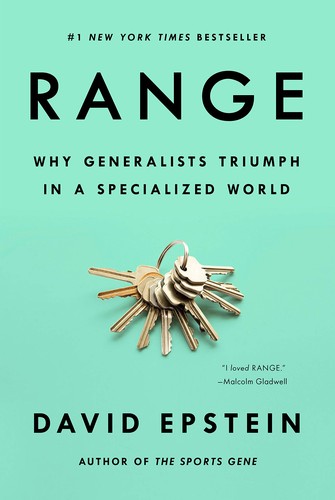
Range
The most effective learning looks inefficient; it looks like falling behind.
Why read it
We're told winners pick a lane at age six and never look up — the Tiger Woods path. Epstein's data says the opposite: in most fields, generalists who sample widely, quit strategically, and start late outperform the specialists.
The 10,000-hours gospel works only in "kind" domains like golf and chess, where patterns repeat and feedback is instant. Most of life is a "wicked" domain — ambiguous, changing, deceptive — and there, breadth wins: range of experience, analogical thinking, and late specialization produce the biggest breakthroughs and the most durable careers.
Epstein, an investigative science journalist, began with a viral debate: why did Roger Federer — who sampled sports until his teens — outperform the hyper-specialized model? Digging into research on forecasting, music, art, and science, he found the Tiger Woods story is the exception that misleads everyone else.
- 01
Kind vs. wicked learning environments
You'll learn to diagnose which world you're in — and why expertise from kind domains creates dangerous overconfidence in wicked ones.
- 02
Sampling periods beat head starts
Elite athletes, musicians, and scientists typically tried many things first; the early lead of specialists evaporates and often reverses.
- 03
Match quality over grit
Quitting a bad fit isn't weakness — economists find people who switch more often end up in careers that fit better and pay more.
- 04
Outside-in problem solving
Why crowds of curious outsiders routinely crack problems that stump insiders — distant analogies beat deep familiarity.
Kodak chemist problems that stumped internal experts for years were solved in months when posted openly — one by a lawyer using knowledge from an entirely unrelated field. InnoCentive built a business on this: the harder the problem, the more an outsider helps.
Vincent van Gogh failed as an art dealer, teacher, bookseller, and preacher, only committing to painting in his late twenties — a serial sampler whose 'wasted' decade became raw material.