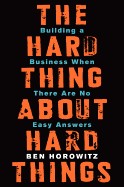
The Hard Thing About Hard Things
by Ben Horowitz
Hard things are hard because there are no easy answers or recipes.
Why read it
Every management book tells you how to set goals and inspire teams. None tells you what to do when you must lay off a third of the company you convinced to join you, or when your best friend's job has outgrown him. Horowitz wrote the missing manual — for the struggle.
There is no formula for the hard things — demoting a loyal friend, managing your own psychology at 3 a.m., choosing between bad and catastrophic. But there is accumulated wisdom. Horowitz mines his years running Opsware through the dot-com crash, twice within weeks of bankruptcy, to codify what CEOs actually face: wartime leadership, telling it like it is, and making decisions with no good options.
Horowitz co-founded Loudcloud in 1999, IPO'd into the dot-com collapse, watched the stock fall to $0.35, pivoted to software as Opsware, and sold to HP for $1.6 billion. The book grew from his blog posts at Andreessen Horowitz — each chapter opens with a rap lyric and a scar.
- 01
Managing your own psychology
The hardest skill in the book: staying functional when every decision is yours, every outcome is bad, and you can't tell anyone how scared you are.
- 02
Peacetime CEO / Wartime CEO
You'll learn why the leadership styles are nearly opposite — and why most management literature only covers peacetime.
- 03
The right way to do layoffs
Painfully specific guidance: move fast, train managers to deliver the message themselves, and address the survivors — your company's future rests on how you treat the leavers.
- 04
Take care of the people, products, and profits — in that order
Why being a good place to work matters most exactly when things go wrong, and how training and promotion signals define your real culture.
With Loudcloud burning cash in a dead market, Horowitz ran a secret two-track plan: negotiate selling the core business while preparing an IPO nobody believed in — the 'figure out what to do when there is no move' chapter every founder eventually lives.
When he demoted his loyal co-founder and friend, Horowitz learned the lesson he passes on: you can keep the person or keep the title, but pretending both fit is how you lose the company and the friendship.