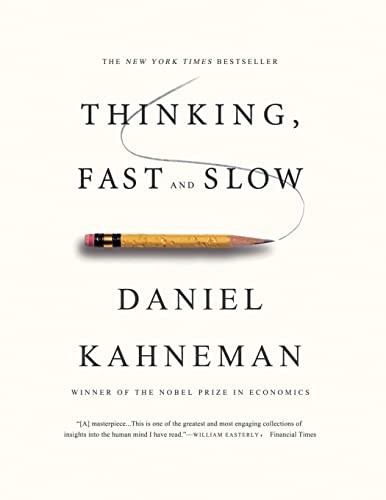
Thinking, Fast and Slow
Nothing in life is as important as you think it is, while you are thinking about it.
Why read it
You believe you reason your way to conclusions. Mostly, a fast automatic system answers first and your slow deliberate mind writes the press release. The Nobel laureate who proved it walks you through every glitch in the machinery you think with.
The mind runs two systems: System 1 — fast, intuitive, effortless, and confidently wrong in predictable ways; System 2 — slow, logical, and lazy. Kahneman's life's work maps the systematic biases this architecture produces (anchoring, loss aversion, overconfidence, base-rate neglect) and shows that knowing them is the beginning — though not a guarantee — of better judgment.
Kahneman won the 2002 Nobel in economics — as a psychologist — for work with the late Amos Tversky that founded behavioral economics. The book is his career synthesis and also a love letter to that collaboration: two friends inventing questions and being surprised by their own wrong answers.
- 01
Two systems
You'll learn to notice when the fast system is answering an easier question than the one you asked — the root of most bias.
- 02
Anchoring and priming
Arbitrary numbers and cues measurably move judges' sentences and buyers' bids; you'll see how much of 'judgment' is context.
- 03
Loss aversion and prospect theory
Losses hurt roughly twice as much as gains please — the Nobel-winning insight that explains insurance, lawsuits, and why you hold losing stocks.
- 04
The planning fallacy and overconfidence
Why every project runs late and every acquirer overpays — and Kahneman's fix, the outside view: ask how projects like this usually go.
- 05
The experiencing vs. remembering self
Your memory keeps only the peak and the end of every experience — with unsettling implications for how you should choose vacations, jobs, and medical care.
'The Linda problem': told about a philosophical, justice-minded student, most people — including statisticians — rate 'feminist bank teller' as more probable than 'bank teller,' a logical impossibility that reveals how stories override logic.
Israeli parole judges granted about 65% of requests right after meals and nearly 0% just before them — hunger, not law, was swinging life-changing decisions.