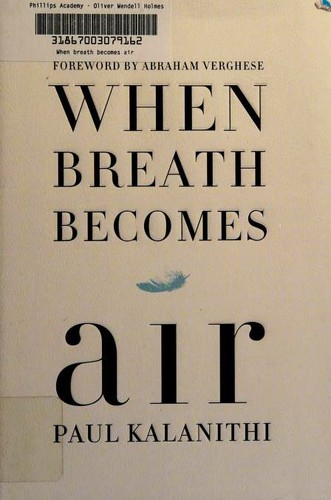
When Breath Becomes Air
You can't ever reach perfection, but you can believe in an asymptote toward which you are ceaselessly striving.
Why read it
At thirty-six, Paul Kalanithi was a year from finishing neurosurgery residency at Stanford — the decade of training complete, the future arriving — when the CT scan showed stage IV lung cancer. The surgeon became the patient, and he wrote his way through the reversal.
A meditation on what makes life meaningful when its length is suddenly in question, written by someone equipped like almost no one else: a literature scholar who became a neurosurgeon precisely to stand where biology and meaning intersect. Kalanithi's answer isn't a bucket list — it's continuing to do what matters (operate, write, love, have a child) inside the time that remains.
Kalanithi held degrees in English literature and the history of medicine before choosing neurosurgery. Diagnosed in 2013, he kept operating, fathered a daughter, and wrote this book in his final two years — dying in March 2015 before finishing it. His wife Lucy's epilogue completes the story; the book became a #1 bestseller and Pulitzer finalist.
- 01
From doctor to patient
The white coat to gown transition, written with clinical precision — including how differently statistics read when the survival curve is yours.
- 02
Why literature, then medicine
Kalanithi's path — Eliot and Nabokov before anatomy — frames neurosurgery as applied philosophy: every operation is a decision about what makes a life worth living.
- 03
Time without a schedule
The cruelest problem: how do you plan when prognosis is a fog? His solution — live as if — is the book's practical gift.
- 04
The decision to have a child
Lucy asks whether a baby will make dying harder. His answer — 'Wouldn't it be great if it did?' — is the sentence readers carry out of the book.
Kalanithi describes returning to the OR mid-treatment, training his body through fatigue to finish a resident's caseload — not denial, but a chosen answer to 'what makes life worth living?'
The final passage, addressed to his infant daughter Cady, about the 'sated joy' she brought his dying days — routinely cited as one of the most affecting pages in modern memoir.